
The Great CDP Divorce
Five not so surprising shifts in the 2026 Gartner Magic Quadrant

For years, the Customer Data Platform (CDP) has suffered from a profound identity crisis. As tools go, they have been stretched like spandex to fit every conceivable role basic data governance to the contextual brain for enterprise AI.
The release of the 2026 Gartner Magic Quadrant for Customer Data Platforms signals perhaps, a more definitive end to this one-size-fits-all era. Are we witnessing a fundamental bifurcation of the market that forces every C-suite leader to choose a side?
Must organizations must move beyond simple data collection toward true customer master data management where data quality and governance are the core pillars of the strategy?
We think so, and here’s some of the thinking as to the “why?”.
What is the difference between Platformization and Agentification
The most significant takeaway from the 2026 report is perhaps the formal divorce between two distinct architectural philosophies: Platformization and Agentification.
This is no longer a race toward a better version of the same tool. It is a strategic fork in the road that requires a choice of underlying operating philosophy. Platformization is the path of the behemoths, Salesforce, Oracle, and Adobe.
Under such a model, the CDP serves as the connective tissue of a massive, integrated application ecosystem; an internal operating system where consent and identity supposedly rule. These aspects then ripple natively across sales, service, and marketing. It offers safety and coordination but demands total architectural and commercial commitment.
Agentification represents the move toward slimmer, warehouse-native architectures where the CDP acts as a context engine for autonomous AI.
Execution shifts from human-managed campaigns to agents that pursue outcomes, such as continuous journey optimization. This approach treats the CDP as a minimal viable platform designed to power a fleet of specialized digital colleagues.
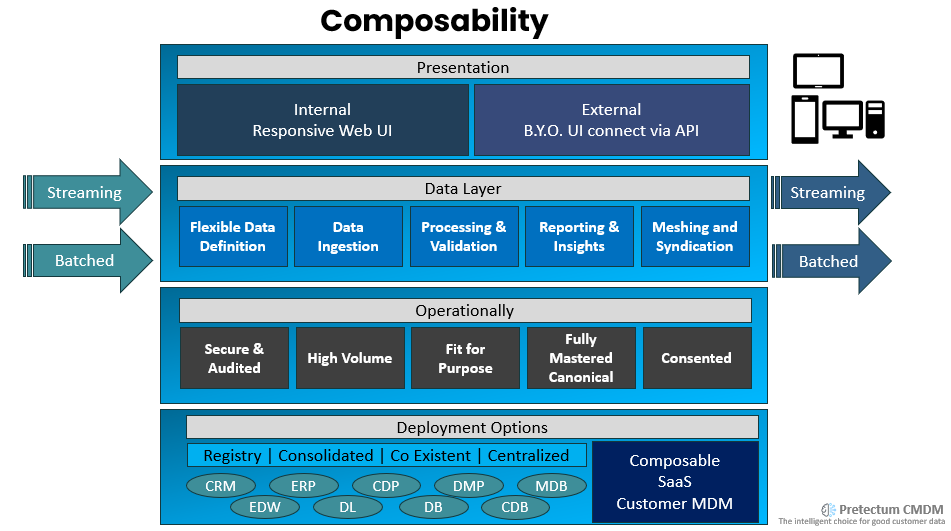
For businesses that find these models too rigid or too experimental, we believe CMDM provides a middle path of unified customer views that prioritizes master data integrity over vendor lock-in.
Why are Composable CDP architectures winning the market?
The rise of vendors like Hightouch directly into the Leader quadrant is the 2026 report’s biggest disruptor – their placement validates the Composable CDP movement, which has matured from a fringe technical preference to a high-impact enterprise strategy.
This shift is driven largely by a growing Marketing Suite Fatigue and a desire for diversification against vendor lock-in. The core advantage here is the warehouse-native architecture.
By leveraging zero-copy querying, these CDPs activate data directly from cloud platforms like Snowflake or Databricks, this eliminates the replication latency and the exorbitant storage costs associated with legacy packaged CDPs that require proprietary data ingestion.
For the C-suite, this is about ownership. Organizations are increasingly choosing to own their data foundation rather than outsourcing it to a single suite vendor. However, even the best composable stack fails without a single source of truth.
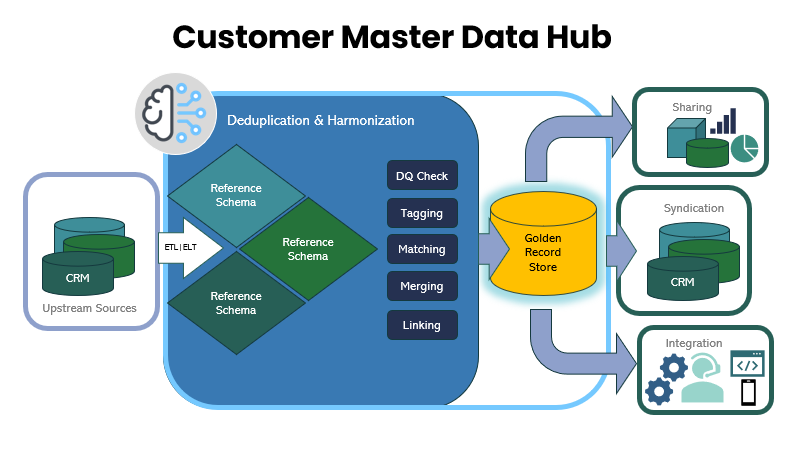
This is where Pretectum CMDM excels, acting as the foundational data quality management layer that ensures the data sitting in your warehouse is actually accurate, deduplicated, and ready for activation.
How does Agentic Process Optimization change customer data strategy?
Gartner has introduced a new, mandatory capability for 2026: Agentic Process Optimization. CDPs are no longer just repositories of record; they are now required to provide packaged AI agents that can autonomously make decisions. This marks the transition from human-led calendar-driven marketing to autonomous, outcome-driven execution.
Key examples include Oracle’s AI Agent Studio and Uniphore’s CDP Agent, which leverage LLMs to deliver a prompt-based user experience for real-time segmentation and audience insights.
This evolution suggests a future where the MarTech stack is radically simplified.
The traditional complexity of dozens of specialized, manual applications is being replaced by a streamlined model of Warehouse + CDP + Agents. In such a high-speed environment, the self-service with consent model offered by CMDM becomes even more critical. AI agents are only as good as the data they are fed; if your customer data profiles lack governance or proper consent markers, your autonomous agents will become a liability rather than an asset.
Why is the CDP mid-market disappearing in 2026?
The 2026 quadrant reflects a dramatic cleansing of the middle ground.
Notable vendors like Zeta Global, Redpoint Global, and mParticle have dropped off the list entirely. Furthermore, Uniphore entered the Leader quadrant specifically following its late 2024 acquisition of ActionIQ, effectively consolidating the intelligent data fabric space.
The “why” behind these departures is critical for buyers. Gartner explicitly updated its inclusion criteria, and these vendors failed to meet the rising bar for CDP software customers and contract value.
This indicates that the CDP is no longer a departmental budget tool but a heavy-hitting enterprise investment. Furthermore, the buying committee has fundamentally changed. The average CDP purchase now involves 2-3 functional groups, including IT, Finance, Sales, and Supply Chain.
Unlike traditional CDPs that struggle with cross-departmental silos, Pretectum is built for customer-centricity, providing a flexible architecture that supports the diverse needs of the entire enterprise while maintaining strict data governance.
How do Data 360 and multimodal context engines drive AI growth?
Salesforce continues to lead the pack by repositioning its CDP; now Data 360; as a context engine. Its primary differentiator is the ability to unify multimodal content. This goes beyond structured records to process various formats of customer interaction, providing a deeper context for AI grounding. The strategy is working, evidenced by a staggering 141% year-over-year growth in paying Data 360 customers. However, the dominance comes with documented friction, including unpredictable credit consumption and murky pricing that can exhaust budgets before organizations realize full value.
When comparing these behemoths to Pretectum, the loyalty differentiation becomes clear. While giants focus on ecosystem gravity, Pretectum focuses on the accuracy and completeness of the customer record itself. By providing a unified customer view that integrates with any ERP, CRM, CDP or DMP, Pretectum ensures that your data-driven personalization is built on a bedrock of quality, not just a mountain of expensive, multimodal noise.
Which side of the fork are you on?
The 2026 Gartner Magic Quadrant confirms that the era of the generic CDP is dead.
Your selection process must now pivot from comparing feature checklists to choosing a fundamental architectural destiny. Do you choose Platformization, doubling down on a comprehensive enterprise operating system that offers governed safety? Or do you choose Agentification, building a lean, warehouse-native engine designed for autonomous AI execution and vendor diversification?
The ultimate question for your organization is no longer about which tool is better, but about ownership and maturity. To avoid the pitfalls of vendor lock-in or the chaos of unmanaged AI, evaluating Pretectum is a vital next step.
It provides the necessary data quality and governance framework to make either path successful. If you are ready to reclaim ownership of your customer data and ensure your AI initiatives are grounded in truth, it is time to look beyond the quadrant and focus on the master record.
#LoyaltyIsUpForGrabs